Realm of science
Welcome to Realm of Science, transcending the boundaries of the known and ventures into the unexplored territories of scientific discovery.
In this, we unravel the mysteries of the universe, delve into the intricacies of the microscopic world, and traverse the ever-evolving landscape of technology. I try to bring you the latest breakthroughs, the most profound theories, and the most thought-provoking scientific debates from around the globe.
Join me on this journey of discovery and let’s explore the wonders of science together.
Ancient Mystery of the Great Pyramids resolved…
If you have been an avid admirer of the Pyramids, then you might have obviously come across some of the greatest unanswered question the 21st century technology cannot answer. That being- How the hell did the ancient Egyptians with such low grade tech move those huge boulders to build the Great Pyramid?? There are many conspiracy theories spooning around & the major one being ANCIENT ALIENS BUILT THOSE !! Well, this long awaiting question for almost 3 centuries has now been answered by ingenious wizards from the University of North Carolina, US.
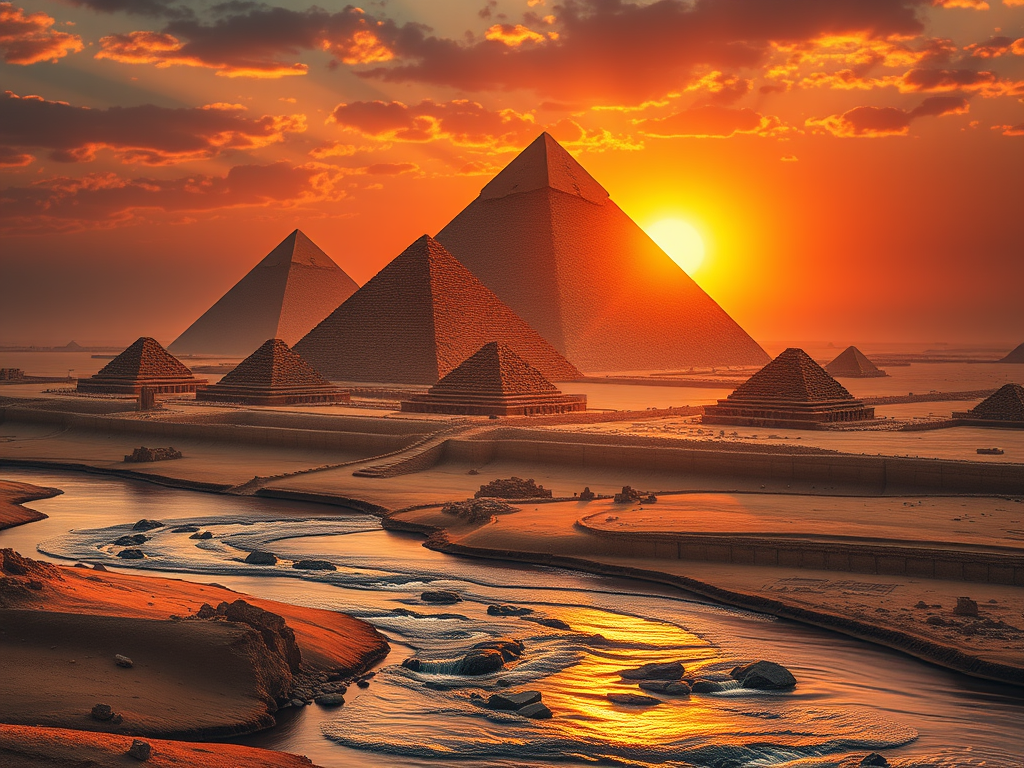
They have discovered a long-buried branch of the river Nile that once flowed alongside the current location of almost 30 Pyramids in Egypt. This 64 km (approx. 40 miles) long river branch ran by the iconic modern day wonder Giza Pyramid as well and was hidden under the desert and farmland for over a millennia.

This existence of a river would explain why the Pyramids were built in a chain in now harsh/ humid desert strip in then Nile valley roughly before 4700 to 3700 years ago. Many archeologists had long believed that ancient Egyptians had used water ways to transport the huge boulders, however due to insufficient data all their thoughts were pushed away as bogus. During the course of study, the International research team from University of North Carolina used radar satellite imagery to map the river branch. The use of ground penetrable radars gave them the ability to study what’s located beneath the sand surface and produce image of hidden features including buried ancient structures and the river Nile itself. Surveys on field were conducted and the presence of a river has also been confirmed that might have dried out due to the drought around 4200 years ago.

Most pyramids had a ceremonial raise walkway which ran alongside that ended right before the earlier existed river. This also significantly implies that the river played a key role in the transportation of enormous building materials and workmen needed for Pyramid construction. These heavy material were mostly from the south and would have been much easier to transport them through waterway than to heave them through land. The existence of river also indicates why the pyramids were built in different spots. Water and its course always changes over the years, hence a 4th dynasty kings would have to make different choice than a 12th dynasty kings.
This discovery reminds us how the geographical conditions, climate & environment plays a vital role in building our history that we seem to uncover everyday.
Capacitors to increase the capability of batteries for EV’s & laptops.
During an unintended study scientists have developed capacitors from new heterostructures (a semiconductor which exhibits superior electrochemical properties such as high conductivity, higher cyclic stability, high energy due synergistic effect between the components.
The new material, if applied alongside batteries could charge up much faster and last longer . As we all understand batteries are primary source of energy to power up our devices, cars etc., but their drawback is they take a tad bit of time to charge & discharge. This is where capacitors come into play, wherein they can be charged quickly & discharged easily. The drawback with these are that they generally retain energy poorly over longer periods compared to batteries. The new heterostructure has both physical and chemical balance between conductivity and non-conductivity letting it to retain energy more effectively than its predecessors. It is predicted that this piece of technology could deliver energy density up to 19 times than the current capacitors.

This miniscule improvement in the capacitors can lead to better storing and access to energy on a faster on demand basis without sacrificing the stability on long-term storage. These capacitors could not only power the cars/ mobile devices but also power industries if they are used up to their full potential.
What happened to the water on Planet Venus ?
Planet Venus as we know today was not a parched piece dryland, but it was a planet that was habitable at one point of time. In a recent study at Laboratory for Atmospheric and Space Physics (LASP) in Colorado, scientist have identified a water loss mechanism that could potentially explain how once water-rich world of Venus became completely dry & sun baked.
In this process, water escaped Venus at double the rate of previously estimated. Based on earlier studies both Venus & Earth likely received similar amounts of water mostly from water vapor spewing volcanoes and icy comets that continuously crashed on this planet. So as well know Venus is far more closer to the sun than our blue planet. This likely boiled away the planet’s water reservoir by breaking atmospheric water molecules into Hydrogen and Oxygen atoms. This lightweight Hydrogen escaped into space via process known as hydrodynamic escape leaving the process of water forming in Venus a impossible task, So, this process explains why Venus has been a dry-land, but however it doesn’t account for water loss of those that was left out post the last molecules of Hydrogen escaping the atmosphere. In the new study, it is found that the remanent water was removed via. a mechanism know as HCO+ dissociative recombination (DR).
In DR a positively charged hydrogen, carbon & oxygen combines with negatively charged electron to produce carbon monoxide (CO) and hydrogen as byproduct post which hydrogen escapes into space. As water is the original source of Hydrogen on Venus, this process effectively dried out Venus.

In conclusion HCO+ has never been observed on Venus as the previous missions to the planet never involved equipments to detect this compound, however individual reactants that produce HCO+ were measured in the atmosphere. Alas, none of the upcoming missions do not have the equipment to measure the amount of hydrogen loss from Venus. A mission planned by NASA in 2031 (DaVinci probe) will collect measurements about pressure, temperature and winds of the atmosphere in Venus below 70 kms.
Establishing the existence of HCO+ and determining this particular stage in Venus’ history will, therefore, require a considerable amount of time.
Chinese secret mission on the dark side of the moon ?
China Academy of Space Technology (CAST) have successfully launched their latest lunar mission- Long March 5 rocket into space. This launch acts as the country’s first mission to collect samples from the moon’s hidden far side and carry them to home planet. This mission is carrying a secret rover to the moon’s far side that was reveled in the Chang’e 6 photo posted by CAST.

The rover is expected to touch down at some point in early June. Very little information is available on the Chang’e 6 mission and its payloads apart from the undisclosed loads from France, Sweden, Italy and Pakistan to the moon. CAST released the photo of lunar lander and the small gray rover highlighted in the image was noticed by journalist Andrew Jones and many netizens on social media platforms.
Hi there, Thank you very much for checking out the Quill. Like what you see? If so, please check in every month for Quills – Realm of Science & Tech.
Until Next time ∞ GODSPEED !