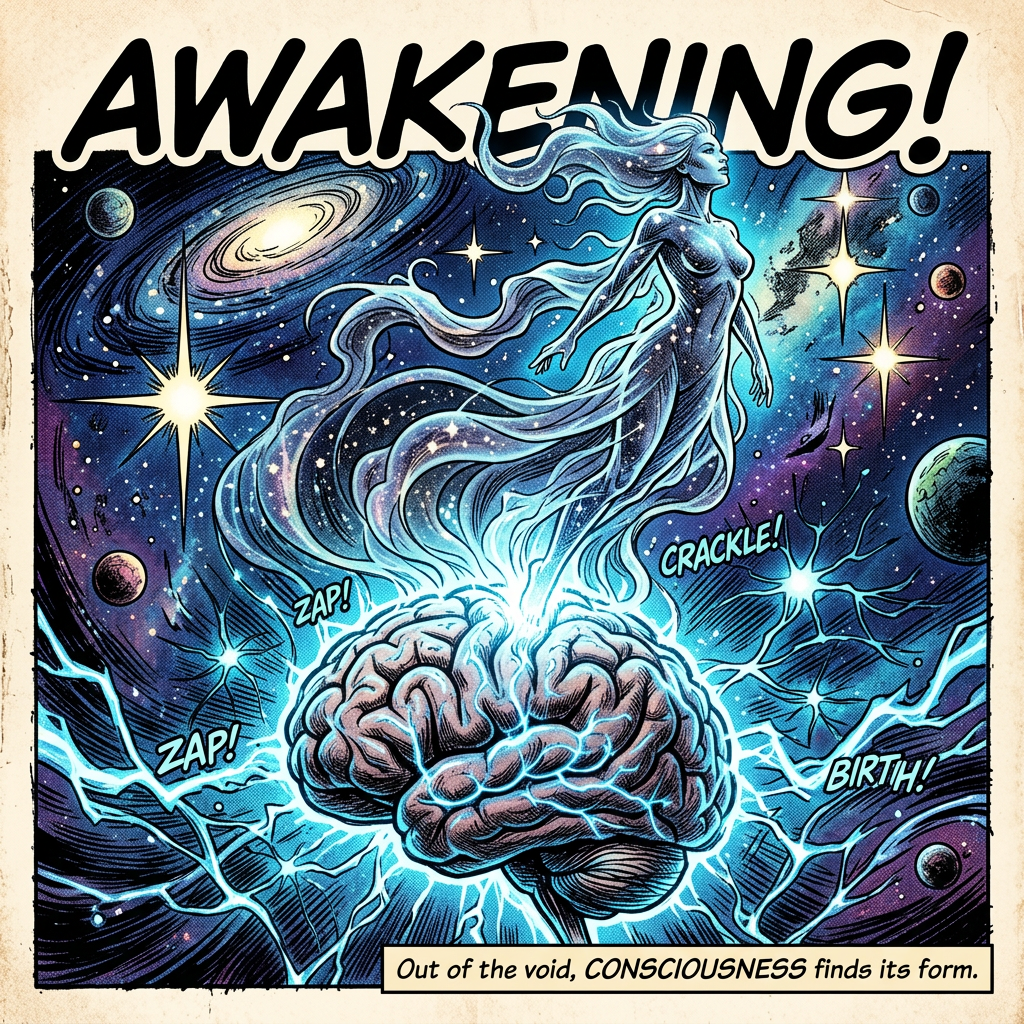
When we try to understand the human brain, we usually picture a biological supercomputer. Eighty-six billion neurons. Trillions of tiny synapses. Electrical impulses firing quietly in the dark. Information goes in. A physical reaction comes out. Clean. Mechanical. Understandable.
But there is a massive ghost in the machine.
Neuroscientists have mapped the wiring brilliantly. We know exactly how the brain processes the light bouncing off a surface, or how a specific nerve sends an urgent signal to pull your hand away from a hot stove. We understand the precise mechanics of survival.
But mapping the wiring doesn’t explain the inner experience.
It doesn’t explain the subjective warmth of the color red. It doesn’t explain the sharp, emotional sting of a distant memory. Most importantly, it doesn’t explain awareness.
How does physical matter—water, fat, and electricity—suddenly generate the quiet, undeniable feeling of being alive?
In science and philosophy, this is famously known as the “Hard Problem of Consciousness.” For decades, the standard assumption has been that if we just study the biological computer long enough, the answer will eventually reveal itself in the complex firing of the brain’s circuitry. We just assumed that if a system becomes complicated enough, it eventually wakes up.
But what if the brain isn’t generating consciousness at all? What if it is merely tuned into it?
Looking at neurons to find consciousness is like looking at the plastic frame of a television to understand the broadcast signal.
You have to look deeper.
The Unlikely Duo and the Orch-OR Theory
In the mid-1990s, a radical answer to this problem emerged from a highly unlikely partnership. Two men looking at reality from completely opposite ends of the spectrum. One was Sir Roger Penrose, a Nobel-winning theoretical physicist. He spent his career working alongside Stephen Hawking, unraveling the mathematics of black holes and exploring the fundamental laws of the universe.
The other was Stuart Hameroff, a medical doctor and anesthesiologist. Every single day, his job was a practical one: to carefully erase human consciousness and then safely bring it back.
Together, they proposed a framework called Orchestrated Objective Reduction, or Orch-OR. And the foundation of their theory started with a remarkably simple, yet profound, medical observation.
When you give a patient anesthesia, they lose consciousness. That much is obvious. But here is what is strange. The brain doesn’t actually shut down. The neurons keep firing. The electrical signals continue to jump across the synapses. The biological computer is still entirely plugged in and running.
For Hameroff, this was the ultimate clue. If the brain’s electrical grid is still actively firing while the patient is completely unaware, then consciousness cannot simply be the byproduct of those electrical signals. The feeling of being alive isn’t in the wiring.
Penrose and Hameroff realized that mainstream science had been looking at the wrong scale. To find the source of awareness, you had to stop looking at how the cells communicated with each other, and look at what was happening inside the cells themselves.
If the magic doesn’t happen between the neurons, where does it happen? The answer is hidden in microscopic tubes.
Microtubules: The Quantum Antenna
To understand where this theory actually goes, we have to look past the neuron itself and zoom into its structural skeleton.
Every brain cell contains billions of tiny, hollow cylinders called microtubules. They are made of a protein called tubulin, arranged in a perfect, repeating helical lattice. For a century, biology textbooks taught that these tubes were just structural scaffolding—the “bones” of the cell that held its shape and moved nutrients around.
But Hameroff noticed something that standard biology ignored: when you give a patient anesthetic gas to turn off their consciousness, the gas molecules don’t block the electrical signals outside the neuron. Instead, they slip inside the cell and bind directly to the hydrophobic pockets of these tubulin proteins. When the gas binds to the tubes, consciousness vanishes. When the gas leaves, consciousness returns.
This was the missing link Penrose was looking for.
Penrose knew that if quantum mechanics played a role in the brain, it couldn’t happen in the messy, chaotic environment of neural firing. It needed a shielded environment. The hollow, water-filled core of a microtubule provides exactly that. The symmetric, crystalline structure of the tubulin lattice acts like a Faraday cage, insulating the interior from the surrounding cellular noise.
This completely flips the standard definition of the brain.
Think of it like an FM radio. If you smash a radio with a hammer, the music stops. But the radio didn’t create the music; it was just an antenna translating an invisible electromagnetic wave. Under the Orch-OR model, the brain is the radio, and consciousness is a fundamental property of the universe—like gravity or spacetime. We don’t generate the mind; our microtubules are the quantum antennas tuned to receive it.

It is a beautiful, radical hypothesis. But it immediately ran into a wall of brutal scientific skepticism. Mainstream physicists pointed out a single, massive flaw that seemingly broke the entire theory.
The “Warm and Wet” Problem
As fascinating as Orch-OR sounded, the scientific community immediately attacked what appeared to be the single fatal flaw in the entire theory.
And honestly, the criticism was not unreasonable.
Quantum mechanics is unbelievably delicate.
In the strange quantum world, particles can exist in multiple states at once, remain entangled across distances, and behave in ways that completely violate our normal understanding of reality. But these states are extremely fragile. The slightest interaction with the surrounding environment causes them to collapse almost instantly, destroying the quantum behavior altogether.
This is why building a quantum computer is so absurdly difficult.
Companies like Google and IBM spend billions trying to engineer environments where quantum states can survive for fractions of a second. Their processors have to be isolated inside ultra-controlled chambers, cooled to temperatures dangerously close to absolute zero. Some systems operate colder than outer space itself. Every vibration, every electromagnetic disturbance, every tiny interaction with the outside world threatens to collapse the computation.
And even under those extreme conditions, maintaining stable quantum coherence remains one of the hardest technological challenges humanity has ever attempted.
Now compare that environment to the human brain.
The brain is warm. Wet. Chemically chaotic. Constantly vibrating with electrical activity and molecular collisions. Billions of neurons firing every second inside a dense biological soup.
To many physicists, the idea of stable quantum states surviving inside the brain sounded completely absurd. It was like claiming you could build a snowflake inside a volcano.
Critics argued that any quantum effects inside microtubules would decohere almost instantly — long before they could influence thought, perception, or consciousness in any meaningful way. Some calculations suggested the collapse would happen in less than a trillionth of a second.
In other words, the theory should not merely fail. It should fail catastrophically. And for years, that criticism nearly buried Orch-OR entirely.
Mainstream neuroscience continued moving toward classical explanations of consciousness while Penrose and Hameroff’s ideas were pushed toward the scientific fringe. To many researchers, the theory sounded less like physics and more like philosophical science fiction wearing scientific language.
Even some physicists who respected Penrose considered this one of the weakest ideas attached to his name. Because if the brain truly behaved like a quantum system, it would mean nature had somehow solved a problem that humanity’s most advanced laboratories still struggle to overcome.
And that possibility seemed almost impossible.
But then something unexpected began happening…
The Laboratory Breakthroughs
For years, Orch-OR survived mostly as a controversial theoretical framework. Fascinating to think about, but impossible to verify. Critics kept returning to the same argument again and again: even if the theory sounded elegant philosophically, there was still no direct evidence that quantum effects were actually happening inside the brain.
Then the experiments started appearing.
And this is where the conversation around consciousness became genuinely strange. One of the most interesting breakthroughs came from researchers studying anesthesia itself — the very phenomenon that originally inspired Hameroff’s ideas decades earlier.
In experiments conducted using rats, scientists began investigating whether microtubules were truly connected to consciousness in a measurable way. The logic behind the study was surprisingly straightforward. If anesthetic drugs disrupt consciousness by interfering with microtubules, then stabilizing those microtubules beforehand should make it harder for anesthesia to “switch off” awareness.

So that is exactly what researchers attempted.
The rats were first given compounds designed to physically stabilize the microtubule structures inside their neurons. Afterward, the animals were exposed to anesthetic drugs.
And something unexpected happened.
The rats with stabilized microtubules resisted the anesthetic effects significantly longer than normal rats.
In simple terms, consciousness became harder to shut down.
That result was difficult to ignore because it directly connected microtubules to the maintenance of conscious awareness. It suggested that these tiny structures were not merely passive scaffolding inside brain cells. They appeared to play an active role in keeping the mind “online.”
For supporters of Orch-OR, this was a major moment. But things became even stranger when physicists started looking at the microtubules themselves. One of the biggest objections to Orch-OR had always been decoherence — the idea that quantum states inside the brain should collapse almost instantly in such a chaotic biological environment.
Then physicist Jack Tuszyński and his colleagues performed experiments involving ultraviolet light and microtubules.
Under normal conditions, biological material should absorb light in fairly ordinary ways. But microtubules behaved differently. When ultraviolet light was fired into them, the structures produced something known as superradiance — a coordinated quantum effect where particles begin acting collectively like a single quantum system.
What shocked researchers was not merely the effect itself.
It was how long it lasted.
The quantum coherence persisted for up to 5 nanoseconds. That may sound ridiculously short from a human perspective, but in quantum physics, especially inside a warm biological environment, it was enormous. Thousands of times longer than many scientists believed should have been possible inside living tissue.
For the first time, there was experimental evidence suggesting that quantum behavior might actually survive inside biological structures under ordinary conditions.
And then came the MRI studies. Researchers at Trinity College Dublin performed customized MRI experiments on human brains searching for something even more controversial: signatures consistent with quantum entanglement.
Entanglement is one of the strangest phenomena in physics. Two particles become linked in such a way that the state of one instantly influences the other, even across distance. Einstein famously hated the idea, calling it “spooky action at a distance.”
And yet, according to the scans, researchers detected unusual signals inside conscious brains that appeared consistent with entangled quantum states.
But the truly unsettling part came afterward. The signals disappeared the moment subjects lost consciousness and fell asleep.
Not weakened.
Not reduced.
Gone.
If these findings continue to survive scientific scrutiny, the implications are enormous. Because suddenly, consciousness no longer looks purely like electrical activity moving between neurons. It starts looking like something deeper is happening underneath the biology itself.
Something operating at the quantum level. And whether Orch-OR ultimately turns out to be correct or not, one thing is becoming increasingly difficult to dismiss: The brain may be doing things modern neuroscience never expected to find. These are not thought experiments anymore. They are measurable quantum events happening inside living, breathing minds.
The most unsettling part of all this is not the possibility that consciousness is quantum in nature, but the possibility that we may have been asking the wrong question from the very beginning. Maybe consciousness was never something the brain created. Maybe it was something the brain learned to access. And if that idea turns out to hold even a fragment of truth, then consciousness is no longer just a biological phenomenon confined inside our skulls. It becomes something far deeper — something woven into the fabric of reality itself.
TL; DR [Curated by AI]
Orchestrated Objective Reduction (Orch-OR) proposes that consciousness may not emerge solely from classical neural computation, but from quantum processes occurring inside microscopic structures called microtubules within brain cells.
The theory was heavily criticized for decades because quantum states are considered too fragile to survive inside the brain’s warm, biologically noisy environment. However, recent experimental findings have complicated that assumption.
Studies involving anesthesia resistance in rats linked stabilized microtubules to prolonged conscious awareness. Separate laboratory experiments observed quantum coherence and superradiance inside microtubules lasting significantly longer than conventional physics predicted possible in living tissue. Additional MRI-based research detected signals consistent with quantum entanglement in conscious human brains — signals that disappeared during unconscious states such as sleep.
None of these findings conclusively prove Orch-OR. Consciousness remains one of the largest unsolved problems in science.
But if the theory is even partially correct, the implications are profound:
Human consciousness may not function purely as a biological computation generated by neurons. Instead, the brain may operate more like a quantum interface — interacting with deeper physical processes embedded within the fabric of reality itself.