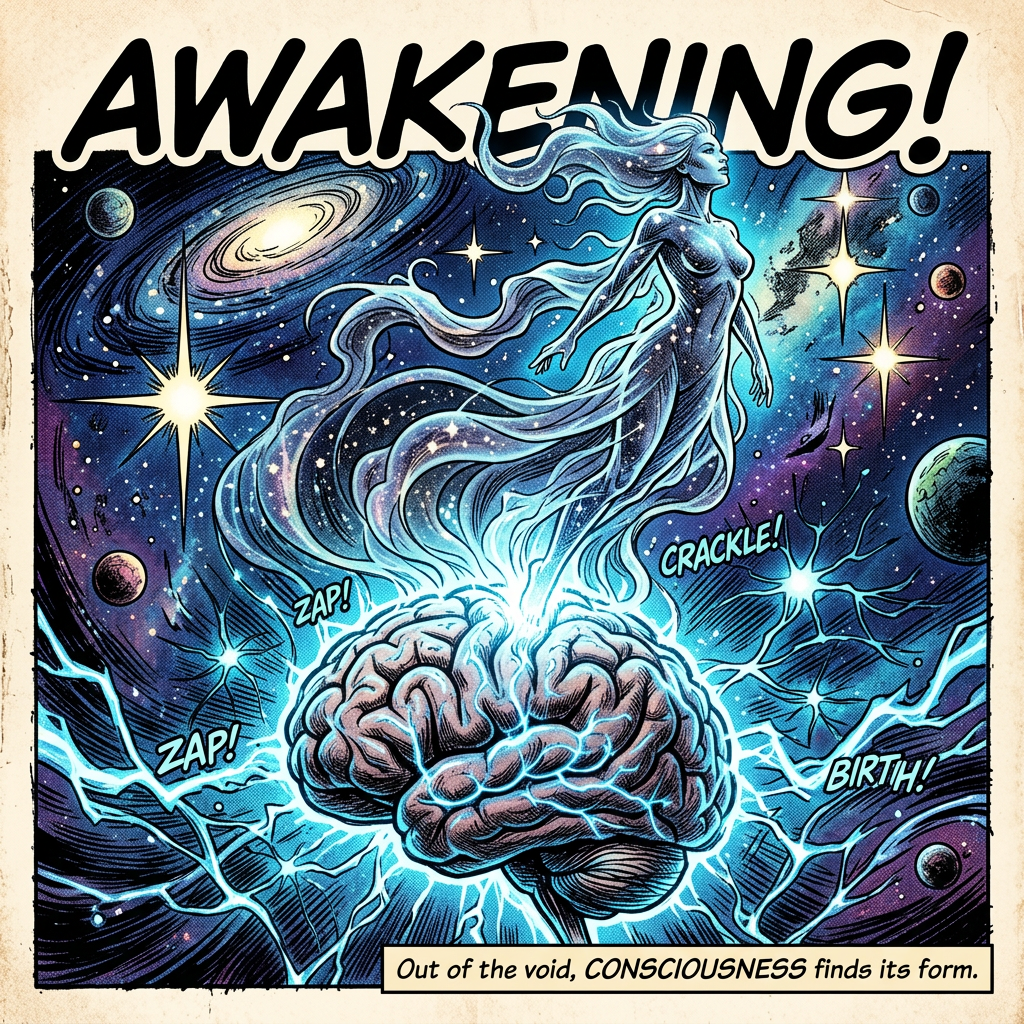
What if your thoughts could bend reality?
No crystals, no chanting under the blood moon, no need to name your vision board “The Cosmic Blueprint 2.0.” Just you, your intentions, and the deepest mysteries of the universe — served with a pinch of quantum magic. Have you ever wished for something so badly that it felt like the universe was eavesdropping?
Maybe it was a job offer, a relationship, or just a parking spot in front of the coffee shop — and then, miraculously, it showed up. Coincidence? Luck? Or is there something more to this universe that we haven’t quite understood yet?
Welcome to the curious, controversial, and captivating world of quantum manifestation — a term that sits uncomfortably at the intersection of science, spirituality, and self-help culture. It’s been called everything from “revolutionary” to “pseudoscientific fluff.” But whether you’re a hardened skeptic, a hopeful mystic, or just quantum-curious, there’s something in this space that sparks the imagination.
The Ancient Roots of Manifestation: Before Quantum Became Cool
Long before the word “quantum” entered the spiritual vocabulary, humans were already playing around with the concept of influencing reality through thought, belief, and intention. In ancient India, the Vedas spoke of sankalpa — a solemn vow or intention, believed to have the power to shape one’s destiny when practiced with unwavering focus. Similarly, Hermeticism (a school of thought from ancient Egypt and Greece) proposed the principle of mentalism: “The All is Mind; the Universe is Mental.”
In other words, the universe was thought to be more like a grand thought experiment than a cold mechanical structure. Sounds a lot like manifestation, doesn’t it?
But here’s the twist: those traditions didn’t need the word “quantum” to validate their beliefs. They didn’t throw particles or wave functions into the mix. They simply observed patterns in nature, in consciousness, and in consequence. Manifestation was understood as a sacred, mysterious process — part psychology, part spirituality.
Fast-forward to today, and it’s dressed in lab coats and called “quantum manifestation.”
Quantum Physics – 101: A Crash Course (Minus the Equations)
If the term “quantum manifestation” is going to make any sense, we first need to understand what quantum physics actually is — or at least, what it claims. At the subatomic level, the universe behaves in ways that seem completely irrational by classical standards. Lets take a look at few key ideas, simplified for sanity:
Superposition: The Quantum Reality That Would Make Even Einstein Twitch
Imagine walking into a room and seeing your friend standing… and sitting… at the same time. Not like switching back and forth — but actually existing in both positions simultaneously. You’d either call an exorcist or assume your vision glitched. But in the quantum world? That’s just another Tuesday.
This strange phenomenon is called superposition, and it’s one of the most baffling — and frankly, rudely confusing — ideas in quantum physics.
Schrödinger’s Sneaky Little Trick
To explain it, we have to bring up that famous cat. You know the one. Schrödinger’s Cat (ahem! if you are The Big Bang Theory fanboy no introduction needed). The feline nobody asked for but every physicist references like it’s the star of a sitcom.
Here’s the deal: Austrian physicist Erwin Schrödinger devised a thought experiment where a cat is placed inside a sealed box with a radioactive atom, a Geiger counter, a vial of poison, and a hammer (because apparently we need maximum drama). If the atom decays, it triggers the hammer, shattering the vial and — well, R.I.P. kitty.
Now here’s the kicker: until someone opens the box, quantum mechanics says the atom is both decayed and not decayed. Which means the cat is both dead and alive. Not metaphorically — literally. Two realities co-existing in one unobserved state.
That’s superposition.
It’s like your Google Chrome browser being both crashed and running perfectly — until you click it. Then it decides.
But wait.. Why does it even matter?
This isn’t just a weird science party trick. Superposition is baked into the very fabric of our universe. Particles — the tiny building blocks of everything — don’t settle on a single state until we interfere. Until then, they live in a cloudy soup of “all possible states at once.”
To be clear: a particle doesn’t “decide” to be here or there, up or down, spinning clockwise or counterclockwise — it’s doing all of them at the same time. That is, until it’s measured. Then, poof. It “chooses” one. Reality snaps into place.
Weird? Absolutely. True? Repeatedly confirmed in experiments like the double-slit experiment (I’ve tried to explain it below).
The Observer: The Cosmic Hall Monitor
If the universe were a classroom, the Observer Effect would be that one Physical Education Teacher (PET) nosy who can’t resist peeking into classrooms when there is no teacher (obviously) — and the moment they do, everyone straightens up and pretends they weren’t doing anything suspicious.
In quantum physics, this meddling “PET teacher” is you — or anything that counts as a measurement or observation. But let’s back up before we get lost in the metaphorical classroom.
So, What Is the Observer Effect, Really?
In its simplest form, the Observer Effect means that the very act of observing something – changes it. Not just “Oh, it looks different now that I see it.” No — it literally behaves differently because you looked at it.
At the quantum level, this is what makes the universe so deliciously weird: particles can be in multiple states (remember Superposition from above?) until something — or someone — interacts with them. The moment you do, the fuzzy cloud of possibilities collapses into one boring reality. Boom. The party’s over.
The Double-Slit Experiment: The OG Cosmic Prank
If you want to see the Observer Effect in action, meet the Double-Slit Experiment, arguably the biggest “gotcha!” in physics.
Picture this: you’ve got a wall with two slits (a very narrow opening) and you fire particles — let’s say electrons — at it, one at a time. On the screen behind the wall, you’d expect two neat lines where the particles went through the slits, right? Logical. Predictable. Boring.
But that’s not what happens. Instead, the particles create an interference pattern — a set of bands that suggest they behaved like waves, splitting and overlapping, as if each particle went through both slits simultaneously. That’s Superposition in action — particles exploring all possible routes at once.
Now here’s where the Observer steps in with a smug grin: scientists decided to watch the particles as they passed through the slits. They installed a detector. Suddenly, the interference pattern disappeared. The particles lined up exactly like you’d expect if they only went through one slit at a time.
Why? Because the moment we “peeped” — the quantum equivalent of a nosy neighbour peering through the blinds — the particles stopped playing the wave game. They settled down and acted “normal.”
In other words: the act of measuring made them pick a single path. The cosmic prank was over.

Everyday Example: The Office Donut Thief
Let’s translate that quantum weirdness. Imagine you’ve got a box of donuts at work. When no one’s around, Bob (let’s consider him as your fav colleague) acts like a particle in Superposition — he’s both stealing a donut and not stealing a donut.
But the moment you peek around the corner and yell, “Hey Bob, whatcha doing?”, he collapses into one version of himself: either donut in hand (caught!) or standing there pretending he was definitely just checking the nutritional label.
Your act of observing changed what “reality” you get. Bob can no longer be both donut thief and innocent bystander. One version must manifest.
Does This Mean Thoughts Control Reality? Not Exactly…
This is where pop-spirituality likes to run wild — and hey, it is fun to imagine. But in physics, “observation” doesn’t always mean a conscious human staring at a particle like a detective at a crime scene.
At the quantum level, any interaction that causes information about the system to become knowable counts as an observation. A photon bouncing off an electron? That’s a “measurement.” An atom bumping into another? Same deal. Nature’s full of PET teachers.
Still, there’s a curious overlap: we humans do “collapse possibilities” in our own lives — not by peering at subatomic particles, but by making choices, focusing our attention, and interpreting our experiences. So, in a poetic sense, we’re quantum observers shaping some version of our reality, moment by moment.
So, Are We The Universe Watching Itself?
Here’s where things get delightfully existential. Some scientists and philosophers like to toy with the idea that consciousness is deeply intertwined with reality itself. Is the universe only “real” because something — or someone — is here to observe it?
It’s a cosmic chicken-and-egg problem: did the universe exist before anything could perceive it? Or does perception bring it to life?
We don’t have a final answer. But we do know that, at the quantum level, the Observer Effect is not an opinion — it’s a measurable, repeatable fact that keeps physicists awake at night.
Takeaway: The nosy PET teacher Lives in All of Us
If Superposition is about infinite possibilities, the Observer Effect is the cosmic reminder that possibility needs a witness to become reality.
Whether it’s a physicist’s detector, Bob in the break room, or you deciding to check on your goals instead of letting them exist in a fuzzy “maybe someday” cloud — the act of looking, measuring, and paying attention changes things.
So next time you wonder if your focus, intentions, or awareness actually matter — remember: in the quantum realm, the universe literally can’t settle down without its nosy PET teacher.
Keep peeking through those cosmic blinds. Who knows what you’ll catch the universe doing when it thinks nobody’s watching.
The Implications (Brace Yourself)
Superposition isn’t just a scientific oddity. It underpins:
- Quantum computing (where bits can be both 0 and 1 at the same time)
- Photosynthesis (yep, plants might use quantum magic to trap light efficiently)
- And potentially… our understanding of consciousness itself
In other words: you’re made of particles that, at their core, don’t follow the rules you think they do. Reality isn’t solid. It’s a probabilistic haze until you look — or poke it.
TL;DR? — Essentials below
Superposition means that a quantum particle can be in multiple states at once — until it is observed. Reality doesn’t settle down until you show up.
Which kind of makes you wonder…
When you’re not looking, what else might be true?
2. The Observer Effect
The mere act of observation appears to influence the behavior of particles. It’s as if particles are camera-shy, only deciding how to behave once someone’s watching. Creepy? Yes. True? Experiments say yes.
3. Entanglement
Two particles, once connected, can affect each other’s states instantly — no matter how far apart they are. Einstein called it “spooky action at a distance.” It’s like having a twin who sneezes when you stub your toe on another continent.
So, what does this have to do with your dream job or soulmate?
This is where things get… interpretative.
Quantum Meets Manifestation: A Cosmic Collaboration?
The theory goes something like this: if the universe is made up of energy and particles that only take shape when observed or measured, then maybe — just maybe — our consciousness plays a bigger role than we thought.
Some proponents (just a fancy word for someone who advocates theories)of quantum manifestation argue that since our thoughts are energetic impulses, they might have the power to influence the quantum field around us. In this worldview, every belief, intention, and visualization is not just a mental exercise — it’s a subtle command to the universe to shape reality accordingly.
It’s an appealing idea. Who wouldn’t want to believe that we are walking, talking architects of our own destiny?
But it’s also where things get dicey. Quantum physicists generally roll their eyes at this interpretation. They argue that quantum effects apply to subatomic particles — not entire job interviews or relationships. According to them, dragging quantum theory into manifestation territory is like using a microscope to predict your horoscope.
Still, the conversation remains open, because consciousness itself remains a scientific mystery.
The Power of Thought: Is There Any Scientific Backing?
Let’s put aside quantum theory for a moment and look at how thought alone has demonstrable power — at least within our own biology and psychology.
– The Placebo Effect
One of the most fascinating and well-documented phenomena in medicine. A sugar pill, given with confidence and belief, can actually heal symptoms in a patient. Why? Because the belief in the cure becomes a catalyst for real physiological change. That’s the mind-body connection in action — arguably a subtle form of manifestation.
– Heart-Brain Coherence
Institutes like HeartMath have studied how our emotional states influence heart rate variability, stress levels, and cognitive performance. When you feel gratitude, calm, or joy — your body responds in healthier ways. It’s not magic; it’s measurable. If your emotions affect your biology, can they also affect your reality?
– Visualization and Goal Achievement
Top athletes, CEOs, and creatives swear by visualization. Studies have shown that mentally rehearsing actions lights up the same neural pathways as actually doing them. In short: your brain believes in the movie playing in your head — and adjusts accordingly.
So maybe the universe isn’t a genie. Maybe it’s more like a mirror. Reflecting back your most consistent focus and emotional frequency.

Skepticism: The Voice of Reason or the Death of Possibility?
Let’s be honest — not everything needs a cosmic explanation.
Sometimes you got the job because you were qualified. Sometimes your “manifested” relationship was just you picking up on subconscious cues and patterns. And sometimes, yeah… that parking spot was just luck.
Skeptics remind us of the confirmation bias: we notice the times our intentions “worked” and ignore the times they didn’t. We connect dots where none exist. And our brain, desperate for meaning, turns randomness into revelation.
These are fair criticisms. Science demands reproducibility, control, and data — not vague anecdotes. But at the same time, science hasn’t fully explained consciousness, intuition, or why we sometimes “just know.”
Perhaps the truth lies somewhere in the middle — between belief and biology, between potential and probability.
How to Practice Quantum Manifestation (Without the Woo-Woo)
You don’t need to meditate on a mountain or bathe in moonlight. You just need to develop a conscious relationship with your thoughts and energy. Here’s how:
- Clarity is Power
Get specific. Don’t manifest “a better life.” Manifest exactly what a better life looks like. Vague requests get vague results. - Feel It as If It’s Done
The universe responds to emotional frequency, not desperate pleading. Think of it like tuning a radio — your feelings set the signal. - Detach from the Outcome
Ironically, the more you obsess, the more resistance you create. Let it go. Trust the process. (Easier said than done, but worth practicing.) - Observe the Signs
The universe whispers before it shouts. Pay attention to synchronicities, intuitive nudges, and small nudges in the right direction. - Take Aligned Action
No, you can’t just sit on the couch manifesting abs. Meet the universe halfway. Manifestation + movement = magic.
Conclusion: Are We Really Creating Our Reality?
The honest answer?
We don’t know. Not completely.
Quantum manifestation sits in the fascinating space between provable physics and personal philosophy. It’s a story we tell ourselves — one with just enough science to be intriguing and just enough mystery to keep the hope alive.
What we do know is this: your thoughts matter. Your beliefs shape your actions. Your actions shape your outcomes. Whether or not that’s “quantum” is up for debate.
But if aligning your mind, emotion, and intention helps you move toward a more meaningful life — then maybe that’s manifestation enough.
And who knows? Maybe the universe is listening. Just not the way we think.
Enjoyed this cosmic dive? Share it, reflect on it, or try it for yourself. The Quantum Voyager is always ready to explore the edges of reality — one curious mind at a time. 🌌